flwyd: (Trevor shadow self portrait)
For many years I've assumed that when I turned 42 I would throw a big party, invite a bunch of hoopy froods, and see if everyone knew where their towel was. As it turned out this week, I had about 2000 people at my birthday party, I didn't have to plan the event, and I didn't see many towels.

Element 11 is a long-standing regional Burning Man event in the Utah desert. It's normally held in July or June, which tend to be prime busy-in-Colorado times, particularly since Apogaea—Colorado's regional burn—is the second weekend of June. This year the organizers moved Element 11 to the last weekend of September, maximizing the amount of planning time in a year of chaos, minimizing the number of excuses for people to not be fully vaccinated, and balancing days which aren't too hot with nights that aren't too cold. Since Burning Man itself was cancelled and I didn't want to go to Plan B/Renegade Burn, I figured I'd have plenty of spoons for a regional in another state. Plus, I didn't have to plan a complicated themed birthday party.

It felt really good to be able to wander around, meet strangers, give hugs, dance to big sound, and share food. So far, it seems the policy of "proof of vaccination or a recent negative COVID test" was successful as I haven't heard that there was any COVID spread at the event. The fact that almost everything was outside certainly helped. I've now got a bit of a scratchy throat and some sore body parts, but my home-COVID test was negative, so I think this is just my immune system having forgotten how to deal with other people's garden variety germs, plus a depleted sleep schedule. I feel significantly less lousy than I did after getting back from a summer road trip.

The month leading up to the event was pretty jam-packed. I spent a bunch of time researching and ordering components for a solar and battery system so that Kelly could sleep with a CPAP, but I didn't give myself enough lead time and the project failed to come together before the trip, culminating in a comedy of errors including a brand new multimeter that needed aluminum foil shoved in the battery compartment in order to operate. Fortunately I've now got months to get things right and up my electrical game before our next camping adventure.

In addition to wrangling electrical components I spent a lot of time in the last month and a half playing with Colorado Redistricting Commission maps. The state has a new citizen-focused redistricting process, ideally reducing the political maneuvering involved, and anyone could submit their own maps and comments. I'm disappointed the commission and staff didn't follow my advice to (a) split census blocks in more natural ways so that neighbors stay in the same district and (b) allow slight variance (order of hundreds) in district size, following the "must be justified" portion of the law. Overall, though, the process seemed to work really well, and almost everyone at the hearings I attended was polite and on-topic, a rarity in the political world these days. There were a lot of "We don't want to be in a district with those people" comments, which make me sad as a collaborationist, but are understandable given the trend in the last half century for people to self-segregate politically.

I also spent a bunch of energy the weekend before Element 11 first picking apples and then helping press them into cider. We ended up with way more fruit than we could process and at the end of the day had more liquid than anyone could take away, particularly when the cooling system failed a few days later. I've got a cider brewing with wine yeast and a cyser (honey + apples) brewing with ale yeast; I'm hoping these turn out better than my last round of cyser which—three years later—still has a harsh flavor. This was a total blast, but cut way down on event packing and prep time.
flwyd: (spiral staircase to heaven)
I have a photographic memory. When I look at a photograph, I remember where I took it.

I got a handheld GPS device in early 2009 and keep it in my camera bag, so all my photos in the last ten years are geotagged. At the beginning of this year I started migrating all 15 years of my photos to a modern hosting platform. I made the, in retrospect, questionable decision to manually[1] geotag the remaining 5 years of photos, starting when I bought a point-and-shoot camera in August, 2003.

This took five to ten times longer than I anticipated. I considered giving up several times, but the existence of a definite time bound and the thought "I didn't take that many pictures that year" kept me going. But now I'm done tagging and will soon be able to announce my new (but still too cluttered) gallery. And it'll have pins all over the map!

[1] And by "manual" I mean "Point Google Earth to the location and then tell GraphicConverter to set EXIF data from Earth."
flwyd: (earth eyes south america face)
We were instructed to create a personal map as homework for an all-day team alignment meeting at work today. The general expectation was that it would be mind map style: your name in the center and branches leading to ideas which play an important role in your life.

Since I'm a map nerd and we're part of the geo team, I decided to dispense with the node/edge modality and use a geographic map as the base. And since laying out and drawing a map of my own psyche is a more involved project than I wanted to undertake, I started by borrowing from one of my favorite maps: Tolkien's map of Middle-earth. I then carefully positioned some of the key pieces of my life upon the rich geolocated symbolism of Arda, arriving at this interesting work:
1.6MiB image )
flwyd: (raven temple of moon)
November 30th was my 8th Googleversary. 8 years is longer than my direct involvement with any other institution, beating my 7½ years at CU and 6 years at Uni Hill. In that time, the Boulder office has grown from around 150 people to more than 700 and my team has grown from a couple rows of cubicles of folks working on the "Google Docs document list" to more than 150 people working on Google Drive in Boulder, plus folks in Los Angeles and New York, and taking a whole floor of the new Pearl Place office. In that time I've worked on adding video support, a server for file viewing, a pipeline to make corpus stats queryable, the new web UI and server, adoption of a new Google framework that standardizes server development and production, migrating and turning down a legacy server, and a not-yet-announced feature to help certain enterprise business processes. "Ask Trevor, he knows everything" has been said by at least one colleague. This isn't the first time I've had wide breadth of impact: I got a "Many hats (literal and figurative)" award when I was an RA in college and I had a hand in almost all pieces of our software products at Tyler-Eagle.

This also marks close to 14 years working on, broadly, enterprise file and content management. While I enjoy helping organizations be more efficient and like wrangling and organizing lots of data (see also: my family's bookshelves), there are other software domains that I'd like to focus on. When I joined Google I figured I'd work on my project for a couple years and then switch to something else and learn something new, ideally working with maps or natural language. The Boulder office has had a geo team since Google first acquired SketchUp yet the team hasn't grown much until now. As of the beginning of 2018 I'll be working with the Street View team to help organize knowledge of the physical world.

When I was sick in 2016, one of the goals I set for my healthy self was to spend more time reading books and making maps. My dissatisfaction with the American political process meant that I ended up shifting my hobby focus from cartography to conversations about climate change and systemic risk. Moving to a geo team at work helps me keep that make-maps promise to myself. And the Street View team is a nice fit given my years spent carefully geotagging all the photos I take while exploring the world. I'm excited about the opportunity to learn geographic data models, image processing, mobile development, and user experience thinking for people navigating the world.

There's an amusing wrinkle in the timing of this team switch. The new Pearl Place campus opened at the beginning of December, so I packed up and moved to the 3rd floor with the rest of the Drive team. The geo team will be on the 2nd floor of the building, which isn't finished yet (as is often the case, Google's growth outpaced expectations when we were planning the building project). So this week I moved back to the old building again with the other left behinds and will move once more in February. Four desks in the span of three months: now that's agile.

The new building is a great place for googling. The desk areas are very open, which I like since it allows for quick collaboration and "hallway conversations." The building also has a lot of areas where folks can retreat for more quiet and focus, including a library with a great view, a nook behind a Hobbit door, and a "hanging lounge." There are also a lot of good social spaces out of earshot of folks' desks and spaces to switch mental gears including a rock climbing cave, a bike workshop, a music room, a giant Google Earth display, and a couple pinball and video game machines. The café on the fourth floor faces the mountains with floor-to-ceiling windows, meaning the kitchen staff get the best view in the place. This is pretty unique: in most buildings, the kitchen has no view whatsoever or maybe has a small window to an alley.

Have a happy new year and may you find your own opportunities for personal growth in 2018!
flwyd: (asia face of the earth relief)
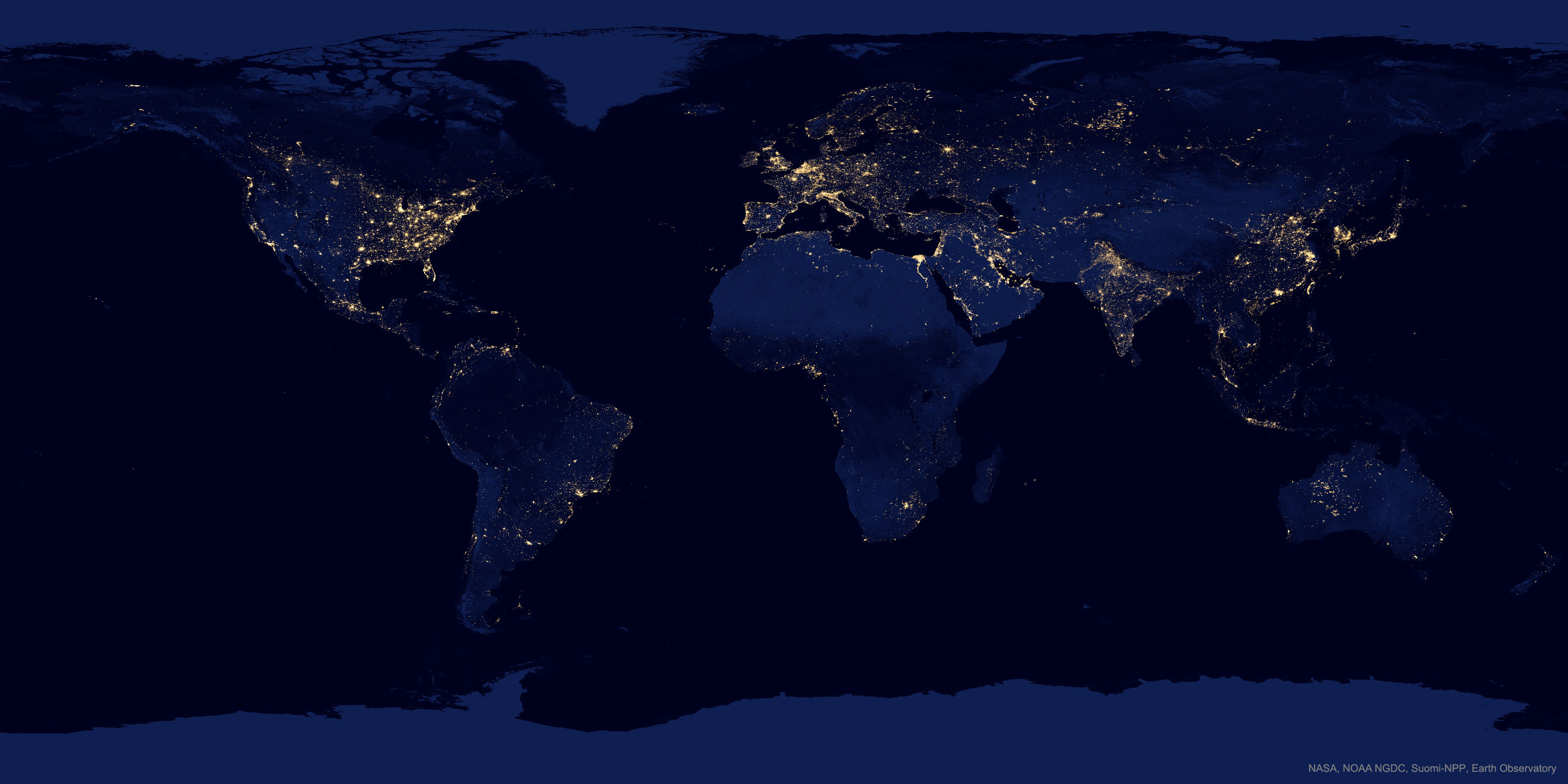
Today's Astronomy Picture of the Day is a nice Earth at Night image from 2012. Click to see the hi-res version:
Earth at Night Suomi NPP 2012

I had an Earth at Night poster in my dorm room nearly 20 years ago. Some notable areas that stand out now:

  • Large oil and gas installations are very prominent, and were fairly absent in the late '90s version of the map. There are lots of very bright lights in…
    • The middle of the Persian Gulf
    • The Bakken formation in North Dakota and the Alberta tar sands
    • Bazhenov formation near the Ob river in Siberia
    • Off the coast of the Niger and Congo deltas
    • To a lesser extent, the coasts of northern Alaska, Louisianna, and Venezuela, and the middle of the Caspian Sea
    • I'm not sure what's up with the bright area the shape of Vermont to the south of Korea and west of Japan. It looks further north than the maps I see when I search [East China Sea oil fields]. Maybe it, the dots between Hainan and Vietnam, like the lines between Argentina and the Falkland Islands, signals night fishing
    • The area around Kyrgyzstan and Uzbekistan is brighter than I expected, too
  • The position of North Korea are very prominence, due to the distinct lack of lights compared to their neighbors
  • Myanmar shows significantly more light than North Korea, suggesting that development there is expanding
  • The Empty Quarter (of Arabia) really is empty
  • Moscow is a lovely 8-pointed star as people have filled in along the arterial highways
  • Metro Bangkok (famous for having the worst traffic in the world) is larger than I'd expected
  • The whole Straight of Malaca is lit up. I'm not sure if that's development on the shore or cargo ships.
  • The brightness of the lower Nile and its delta are always striking. I suspect this may be in part due to the presence of the Aswan dams generating power, not just the population density
  • Israel is somewhat brighter than its neighbors, though western Jordan is fairly solid
  • Europe has several areas that are basically solid light, with big cities only slightly brighter while America has very prominent metropolises with more subdued dots (in the east) and open space (in the west)
  • Speaking of the American east–west divide, there's almost a vertical line from Winnipeg do the mouth of the Rio Grande separating the "plenty of people" part of the country from the "a few metropolitan oases until you get to the Pacific coast" part of the country
  • Though a little less distinct, there's a ring around much of the Tibetan Plateau
  • The Caspian coast of Iran is a more populated area than many folks realize
  • Many folks would also be surprised by the brightness of Java, though as the most populous island in the world it should be expected
  • Taiwan has an interesting western crescent of light
  • Puerto Rico is almost as bright as the Florida coast
  • McMurdo Station doesn't make enough light to show up, but Antarctica has a high albedo, even at night
  • Not only are there very few lights in the Congo rainforest, it also reflects less moonlight than the deserts to its north, south, and east. The Amazon has a similar effect.
  • If you're wondering what's up with West Australia, the images were taken when bush fires were burning

flwyd: (1895 USA map)
When you write a story down, it only happens one way.
When you adapt a book to film, the characters have specific appearances.
When you draw shapes on a map, a smeared spectrum becomes four crisp colors.

I want to expound more on these ideas in a blog post, but starting the year with an intellectual all-nighter wouldn't be very auspicious.

Murder Sandwich

Wednesday, March 14th, 2012 11:58 pm
flwyd: (1895 USA map)
Originally posted by [livejournal.com profile] vsmallarray at Murder Sandwich

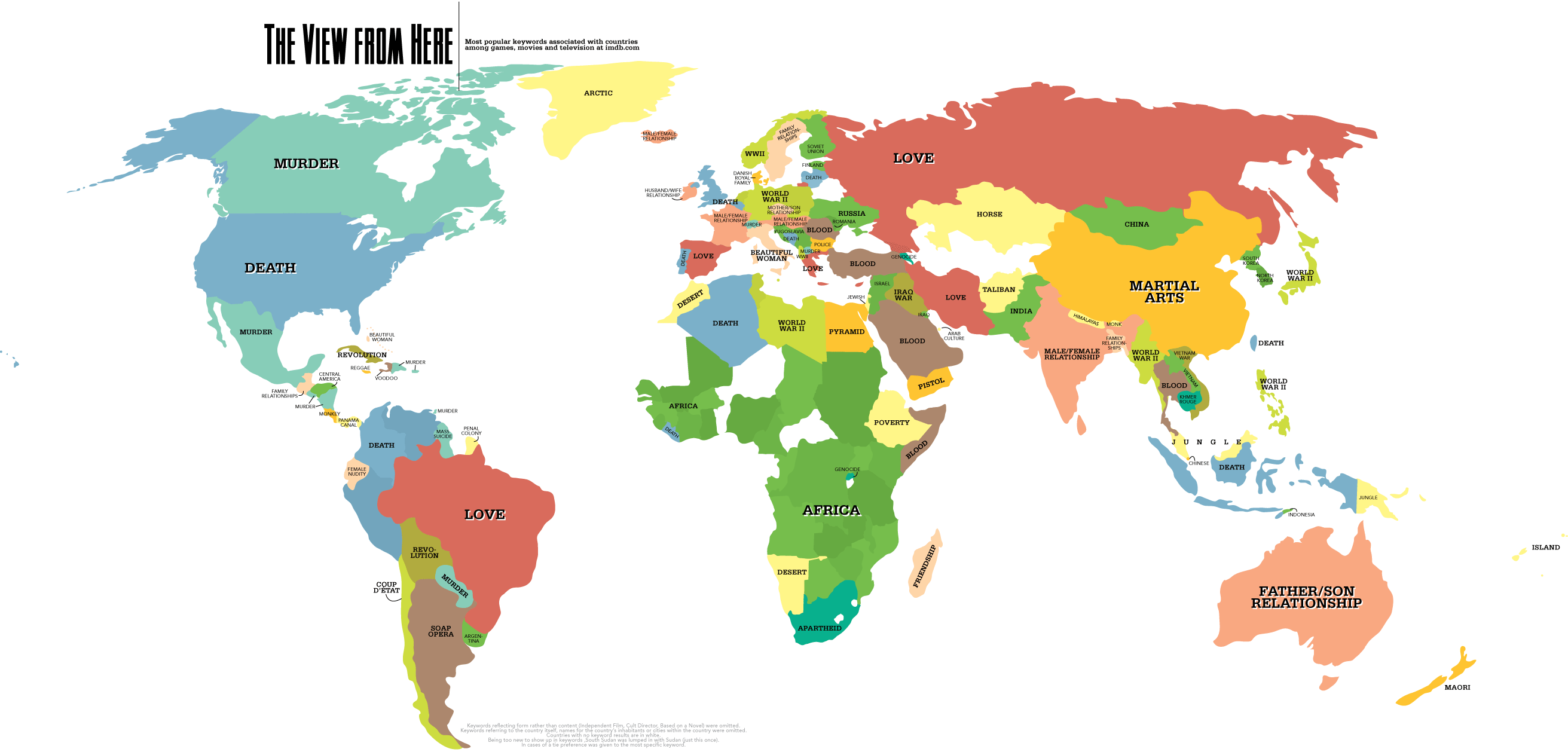
I'm not sure if I feel worse for the countries that don't have any films about them, like Suriname, the countries associated with something horrible, like Armenia -> genocide, or the countries whose main film association is another country, like Pakistan -> India.
[livejournal.com profile] vsmallarray is the infographic project of the artist behind [livejournal.com profile] catandgirl.
flwyd: (asia face of the earth relief)
Google Earth has some pretty cool ways to view buildings in 3D, but like any great technology, after a while it seems ordinary. So it was a big "Whoa" moment when I saw what Baidu, China's largest search engine, is doing with their SimCity-style building layer:

Tiananmen Square and the Forbidden City, Zoom in on Mao's portrait
Shanghai too
Sprawling Guangzhou and the second tallest building in the world, the Canton Tower
Apartment buildings in Shenzhen Even the highway interchanges are 3D.

What meets Where

Sunday, January 31st, 2010 11:31 am
flwyd: (1895 USA map)
I've added the Google Maps Module, so now you can view my photo gallery geographically. You can use the map to find clusters of photos I've taken since I got my GPS device early last year, plus some album coordinates I set by hand. The "View Album on a Map" link is available even on albums without any geography information. My server is not very fast, so the user experience isn't as snappy as browsing my geotagged photos on Picasa, but I've got more pictures on my main gallery.

Photos and maps, two of my favorite things to stare at!
flwyd: (1895 Colorado map)
My mom fetched a large roll of wrapping paper from the basement. After trying to remove some of it, she discovered that it was actually a wrapped cardboard tube. On the end, there was a tag, addressed to my uncle, from my mom. This implies that on Christmas at least two decades ago, this present was camouflaged and forgotten, then subsequently consistently mistaken for a normal roll of wrapping paper.

Rather chuffed at her discovery, my mom gave me the present, a large map of Colorado. Is it re-gifting if the intended recipient never got the gift in the first place?

Tech Support Elf

Thursday, December 24th, 2009 02:20 am
flwyd: (asia face of the earth relief)
NORAD intelligence reports indicate that Santa does not experience time the way we do. His Christmas Eve trip seems to take 24 hours to us, but to Santa it might last days, weeks or even months. Santa would not want to rush the important job of delivering presents to children and spreading Christmas to everyone, so the only logical conclusion is that Santa somehow functions within his own time-space continuum.
NORAD Tracks Santa FAQ
As a Colorado kid, I knew two things about NORAD: It's an air force base inside a mountain and every Christmas Eve they appear on local news to update viewers on the location of Santa.

In the high-tech 21st Century, you don't have to wait for the local news to tell you where Santa is; you can watch his progress live in Google Maps and even in 3D with Google Earth. The technology gets better and the cultural heritage lives on. Santa is perhaps the best example of the mythic process alive in contemporary society.

A "volunteer to answer tech support email" list got passed around Google, so I've been enjoying reading questions from kids, thanks from parents, and reminders that not everyone is as skilled at using a web browser as I am.

Naughty, nice, or both, I hope you all discover a wonderful gift soon. (Take that as metaphorically as you like.)

LOLgeography

Wednesday, April 1st, 2009 09:13 am
flwyd: (1895 USA map)
This is the funniest thing I've seen in weeks. From [livejournal.com profile] vsmallarray, the charts and graph project of Dorothy Gambrel, artist for [livejournal.com profile] catandgirl and [livejournal.com profile] donationderby.

Update February, 2011: Somehow this post has become the most popular one on my journal for comment spam, so I've disabled comments.

Geograpun

Friday, January 12th, 2007 09:55 pm
flwyd: (asia face of the earth relief)
If you go out to dinner with a map maker, you'll be dining a la cartographer.

Love Writ Large

Monday, December 11th, 2006 02:19 pm
flwyd: (tell tale heart)
Someone in Long Island City has a creative way to pop the question. (Be sure to close the info balloon to see what's up.)

Thanks to [livejournal.com profile] polonius for the discovery.
December 1 2 3 4 5 6 7 8 9 10 11 12 13 14 15 16 17 18 19 20 21 22 23 24 25 26 27 28 29 30 31 2025

Most Popular Tags

Expand Cut Tags

No cut tags

Subscribe

RSS Atom
Page generated Monday, December 29th, 2025 03:53 am
Powered by Dreamwidth Studios